


If you’ve spent any time on TikTok lately, you may have come across marketing strategist and creator Sam Ogborn, who has been calling out a subtle but powerful shift in how brands are showing up online heading into 2026. Her observation, rooted in consumer brands and culture, is simple but profound: we’re no longer operating on a single internet.
Instead, we’re living in two.
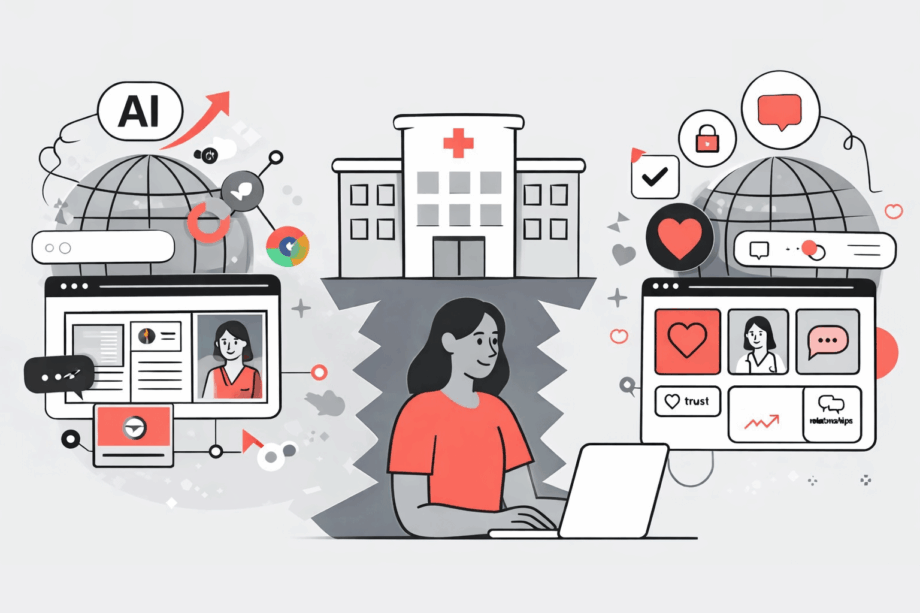
On one side is the open internet—search, social, AI-generated answers, and content that’s easily skimmed, summarized, and often stripped of its original context. On the other is a more intentional, owned internet—private feeds, newsletters, memberships, and brand experiences designed for people who want more than a one-time interaction.
While Sam’s original insights weren’t about healthcare, the implications for hospital and health system websites are enormous.
From information hubs to relationship platforms
Historically, hospital websites were built to answer questions:
- What services do you offer?
- Who are your doctors?
- Where are you located?
That model worked when attention flowed predictably from search engines to websites. But today, AI tools increasingly answer those questions before a user ever reaches a hospital site.
The takeaway isn’t that hospital websites are becoming irrelevant—it’s that their role is changing.
In a two-internet world, public-facing hospital pages still matter. They establish credibility, accuracy, and trust. But they’re no longer the finish line. They’re the starting point.
Why “open” alone is no longer enough
Sam’s broader consumer insight is that brands are losing control when everything they publish lives exclusively in public spaces. Content becomes interchangeable. Loyalty erodes. Relationships flatten.
Healthcare faces a similar risk.
Undifferentiated service-line pages, generic health library definitions, basic provider bio data, and static FAQs are increasingly easy for AI systems to replicate. What can’t be replicated is continuity—recognition, relevance, and trust built over time.
This is where hospital websites must evolve from content libraries into experience platforms.
The rise of layered experiences in healthcare
Leading consumer brands are responding to this shift by layering their digital experiences:
- Public content introduces the brand
- Deeper value appears after engagement
- Ongoing relationships happen in owned channels
Health systems are uniquely positioned to do the same—often better than consumer brands—because they already operate within long-term relationships that span years or decades.
In practice, this means:
- Designing journeys instead of isolated pages
- Offering deeper guidance as trust increases
- Connecting website experiences to email, portals, and follow-up content
- Treating engagement as something that unfolds over time
Authenticated experiences—where users are recognized and remembered—are one tactic that supports this shift, but they’re not the whole story. The bigger idea is intentional progression, not locking content behind logins.
What this means for hospital marketers
The most important takeaway from Sam Ogborn’s trend lens is this:
The future belongs to brands that move from broadcasting to hosting.
For hospital and health system websites, that translates into a few strategic priorities:
- Use public pages to orient and reassure, not overwhelm
- Create clear “next steps” that invite deeper engagement
- Reserve your most valuable, contextual guidance for ongoing relationships
- Measure success beyond traffic alone—look at return visits, engagement depth, and continuity
A final thought
AI and social platforms may dominate the open internet, but they can’t replace what healthcare does best: build trust over time.
The opportunity for hospital websites isn’t to compete with AI for answers—it’s to become the place where answers turn into relationships.
And that’s a future worth designing for.
___________________________
Credit: This article was inspired by consumer brand trend insights shared by Sam Ogborn, social media content creator and marketing strategist, and reframed here for hospital and health system digital leaders. If you liked this article then check out the inspiration behind it here:
https://www.tiktok.com/@samogbornn/video/7473649694929964331?is_from_webapp=1&sender_device=pc&web_id=7501150232320214571
And here:
https://www.tiktok.com/@samogbornn/video/7589907781709352222?is_from_webapp=1&sender_device=pc&web_id=7501150232320214571